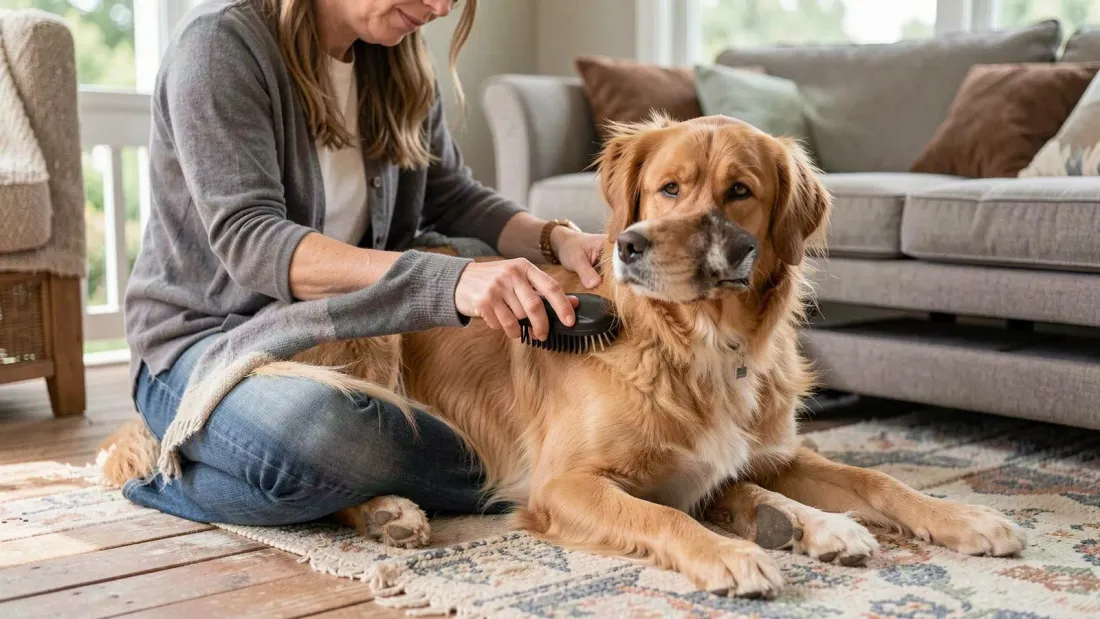
Dog Grooming Brush: What to Look For Before You Buy
The brush is the tool you will actually use
If a household is going to keep one grooming tool by the door, it should be a brush, not a clipper. A dog grooming brush is what prevents most of the mess that later gets blamed on “we need a shave.” It pulls out the loose undercoat before it hits the sofa, finds flea dirt and burrs, and tells you whether the skin looks ordinary today. Clippers and trimmers are occasional tools. The brush is the weekly one.
The ASPCA’s dog grooming tips make the coat type the starting point, not the brand. A smooth, short coat is not brushed the same way as a dense retriever coat or a long coat that tangles behind the ears. Buy for the coat you have, and for the places on that dog that mat first: the collar line, the armpits, the trousers, the tail. If the skin is already sore, or you can see scabs, bald patches, or an unusual amount of scratching, put the new brush down and call the veterinarian. This is a buying guide, not a skin clinic.
Coat type decides the shape of the brush
People often buy a slicker brush because the phrase “slicker brush dog grooming” shows up everywhere, then wonder why a short-coated dog looks scratched. A slicker is a pad of fine, angled wire pins. It is excellent at lifting loose hair and working through early tangles in medium and long coats. It is easy to press too hard. On a thin-skinned dog, or on the face, a heavy hand with a slicker is a good way to make grooming into a fight.
A bristle brush is often enough for short, smooth coats, and it is a good finishing tool after a slicker or a rake has done the heavier work. A rubber brush or curry can loosen dead hair on a short coat and is often more comfortable for dogs that dislike pins. An undercoat rake or a wider-toothed comb helps on double-coated dogs during heavy shed, when a slicker alone skims the top and leaves the underlayer packed. A comb is not optional if you have a long coat. It is how you check that a patch that looks brushed is not still knotted at the skin.
You do not need every tool on day one. You need one tool that reaches the loose hair in this coat, and one finer tool that checks the work.
A comparison table by coat and job
This is a matching table, not a ranking and not a lab test. If your dog is a mix, go by the hair you can actually hold, not by the breed guess on the paperwork.
| Coat or job | Tool that usually fits | What it should do | What to watch |
|---|---|---|---|
| Smooth, short coat (think a Boxer or a similar short jacket) | Rubber brush or curry, then a bristle brush | Loosen dirt and dead hair, then sweep it off | Pins that are longer than the coat will just scrape skin |
| Short, dense coat that sheds in handfuls | Slicker, then bristle, or a rake made for undercoat | Lift the loose underlayer, then finish the surface | Stopping at the top inch and calling it done; the undercoat will still come off on your clothes |
| Medium or long coat that tangles | Slicker used in sections, plus a comb | Work from the ends toward the skin, then comb through to the root | Pressing a slicker straight down into a mat and hoping it melts |
| Silky feathers on ears, legs, and tail | A narrower slicker or a comb with both wide and fine teeth | Keep the feathers from knotting where they rub | Skipping the behind-the-ear patch because it looks “fine from above” |
| Tight curls or woolly coats | Comb plus a slicker, used often, in small sections | Keep the coat from felting; find mats early | Waiting two weeks, then trying to drag a rake through a felted jacket |
| Face, paws, and tight spots | A small, softer brush or a comb | Tidy without poking the eye or the thin skin on the inner leg | Using the same stiff body slicker on the muzzle |
| Checking for parasites or skin changes | Any brush you already use, plus your hands and eyes | Part the coat, look at the skin, notice flea dirt, ticks, lumps, or soreness | Brushing in the dark, as fast as possible, and never looking at the skin |
A “self-cleaning” slicker can be convenient if you actually empty it. If the hair stays packed in the pins, the tool starts to slide over the coat and scratch. Clean it as you go.
How a brushing session should feel
Short, regular sessions beat a monthly battle. The ASPCA notes that some short coats can be brushed about once a week, while longer or denser coats need more frequent work; let the comb, not the calendar, tell you. If the comb snags, you waited too long, or you skipped a section.
Work in layers. Hold the hair up with one hand and brush the hair below it, so you are not polishing the surface while a mat forms underneath. Start at the ends of a tangle and move toward the skin. If you meet a mat that will not yield with a little hold-and-separate work, stop. Cutting mats out with scissors, or ripping them out with a rake, is how people injure a dog at home. That is a groomer’s job, and sometimes a veterinarian’s, if the skin underneath is already damaged.
Use the session to look. Part the coat along the back, at the tail base, and in the armpits. Flea dirt, ticks, burrs, and small scabs show up here first. The ASPCA also reminds owners that grooming time is a chance to notice those flea specks. Do not treat a brush as a treatment for an itching dog. If the dog is sore, stop.
Keep a towel on your lap or a mat on the floor. Brush in the direction the coat grows, with enough pressure to reach the loose hair and not enough to redden the skin. If the dog leans away, you are going too hard, too long, or at a place that already hurts. End on a part of the body the dog likes, even if that means the glamorous trousers wait until tomorrow.
A short checklist before you buy
- I can name the coat I have: short and smooth, dense and shedding, long, or curly
- The first tool matches that coat, and I have a comb if the hair can tangle
- The pins or bristles are not harsher than the skin can stand
- I can clean the brush easily
- I will work in sections, from the ends toward the skin
- Serious mats go to a professional, not under a pair of household scissors
- If the skin looks wrong, I will call the veterinarian instead of buying a stiffer brush
Questions that come up at the shelf
Is a slicker brush the right default for every dog?
No. A slicker is a strong tool for loose hair and early tangles in coats that can hold them. On a short, smooth coat it is often more tool than you need, and on thin skin it can be uncomfortable if you press. Match the brush to the hair, then use a light hand.
How do I tell a good slicker from a harsh one?
Look at the pins. They should be even, not hooked into little spears, and the pad should flex a little rather than sitting like a block. Try the brush on the inside of your forearm. If it feels scratchy on you, it will feel worse on a belly. Price is not a guarantee of softness.
Can brushing replace a bath or a haircut?
Brushing keeps a coat cleaner and reduces tangles, but it does not replace a bath when the dog is dirty, and it does not shorten a coat that truly needs clipping. The ASPCA’s bathing advice still starts with a brush-out, then a thorough rinse and dry. Get the order right and you will fight fewer mats.
What if my dog hates being brushed?
Usually the dog has been scratched, rushed, or held still for too long. Switch to a gentler tool, work in one-minute sessions, and start at a place the dog already accepts, such as the chest. If the resistance is new, or the dog snaps when you touch one spot, have the veterinarian check for pain before you call it a behavior problem.