Dog Grooming Hair Trimmer: What to Look For Before You Buy
A trimmer is a detail tool, not a smaller clipper
The first trimmer we bought was sold as if it would “do the whole dog.” It did not. It chewed at the shoulder, grew hot in about a minute, and made a tidy job of the fur between two paws before the battery faded. That was actually useful information. A dog grooming hair trimmer is for the awkward edges: the face, the ears’ outer hair, the sanitary area if you have been shown how to do that safely, and the tufts that collect mud between the pads. It is not a substitute for body clippers, and it is not a pair of scissors.
This distinction saves money and skin. Full-size clippers can be clumsy around a muzzle. Scissors, in an untrained hand, are worse, especially near the eyes and around mats. The ASPCA’s advice on home haircutting is conservative for a reason: a light trim of clean, dry fur around the face, feet, and tail can be reasonable, but the organization advises against shaving a pet, and it recommends leaving real haircutting to a professional. Read their notes on why shaving is a bad home project and their general grooming tips before you shop. Nothing in this guide is a medical instruction. If the skin is red, the eyes are irritated, or your dog will not let you near a paw, stop and ask a veterinarian or a groomer.
The jobs a trimmer should be able to do
Think about the three or four passes you actually need, not the lifestyle photo on the listing.
Face and eyebrows: you want a narrow head you can see past, and a length that tidies hair out of the eyes without leaving a shaved patch on the muzzle. Many dogs will only tolerate a few seconds here. A trimmer that starts loudly, or that has a wide blade, will not get a second chance.
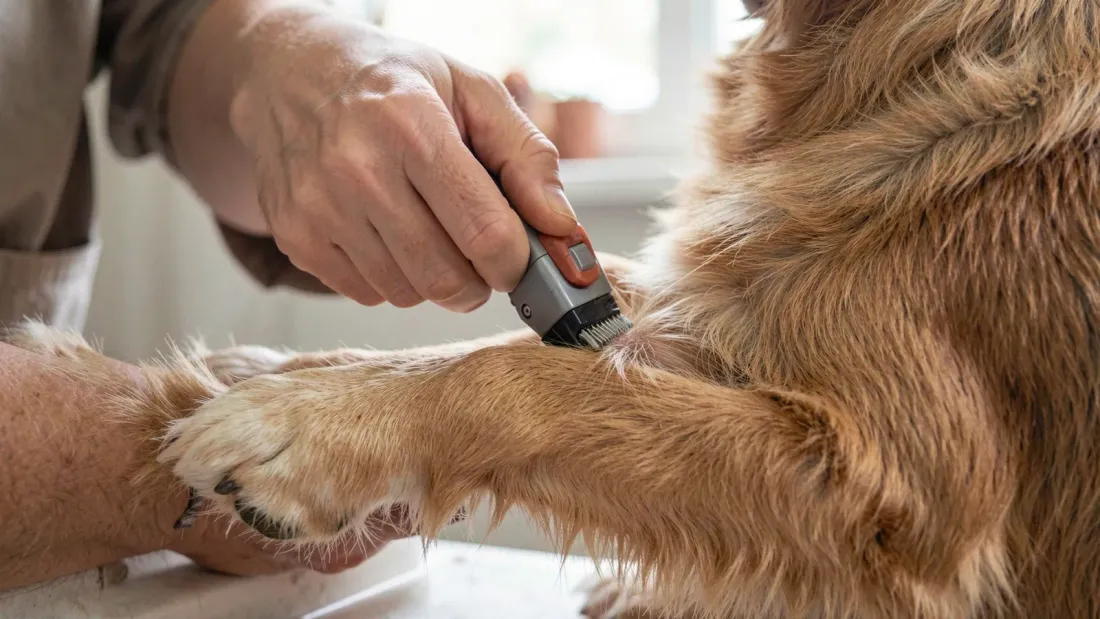
Paws: hair between the pads mats, collects ice in winter, and picks up seeds in summer. A slim trimmer, used on a still, well-held foot, can keep that hair even with the pads or slightly shorter. This is slow work. If you have never been shown how to hold a paw and keep the skin flat, ask a groomer to demonstrate once. It is cheaper than a nick.
Edges and sanitary trimming: a shorter, guarded length is the point. You are not trying to sculpt a show trim. You are trying to keep urine, feces, and mud from clinging to long hair. If the dog is badly soiled or the skin underneath is sore, that is a hygiene and health problem, not a styling one.
If your real need is a shorter coat on the ribs and back, look at body clippers instead. Buying a “kit” that is only a detail trimmer with a few plastic combs will not get you there.
A criteria table for face-and-paw trimmers
No invented bench tests here. These are things you can inspect before you pay.
| What to check | Why it matters | A reasonable sign | A warning sign |
|---|---|---|---|
| Head size and sight line | You must see what the blade is doing near eyes, lips, and pads | A narrow or T-shaped head, with the cutting edge visible as you work | A wide body clipper sold as a “trimmer,” blocking your view of the skin |
| Remaining hair length | Faces and paws look better, and stay more comfortable, with some hair left | Guards or a fixed length that tidies rather than shaves | Only a bare, close blade, especially on a pale or sun-exposed muzzle |
| Noise at start-up | The first second of sound is when many dogs pull away | A tool you can turn on away from the dog, then bring closer | A sharp, high-pitched start and no return policy |
| Heat in a short session | Detail work is close to thin skin | The housing stays comfortable after a minute in your hand; you can pause and swap a blade or let it cool | A tiny motor that is already hot after a quick test on your own arm hair |
| Battery or cord in tight spaces | You will work under a chin and between toes | A slim cordless body, or a very light cord that stays behind your wrist | A bulky handle, or a cord that drags across the dog’s face |
| Cleaning | Face hair and paw grit clog a small blade quickly | A brush, oil, and a blade you can actually open or replace | A sealed toy-like unit with no cleaning tools |
| Grip when the dog moves | One hand holds the paw or muzzle; the other holds the tool | A shape you can control like a pencil or a small razor | A heavy, rounded body that wants to roll in the hand |
| What the listing is really selling | You need a detail tool | The product is clearly a pet trimmer for face and feet | A human beard trimmer with a stock photo of a dog, and no pet blade care advice |
If you already own decent body clippers with a narrow blade option, you may not need a second machine. Try that first on a low-stakes area, such as the fur above the paw, before you buy.
How we use one without turning it into a wrestling match
Work on a dry, brushed dog. Wet hair clumps and pulls. Sit on the floor, or use a non-slip mat on a table with a second person if the dog is large. Never lean a dog’s neck over a counter edge to “get a better angle.”
For the face, rest your hand so it both steadies the muzzle and protects the eyelid. Use short, shallow passes, and stop if the dog shakes or paws at the tool. Hair that still falls into the eyes after a conservative trim is a reason to book a groomer, not to press closer to the lid. For paws, hold the foot so the pads are open and the skin between them is flat. Trim a little, set the foot down, and let the dog reset. If you find a seed, a smear of tar, or a cut in the pad, put the trimmer down. Cuts, cracks, and burns are veterinary problems; the ASPCA’s paw-care notes on the same grooming page are a reminder that pads take weather and road salt poorly, and that deeper wounds need a veterinarian.
Clean the blade after every session. Face hair plus saliva is a remarkably efficient way to gum up a cheap trimmer. If the tool starts to pull, it is dull, dirty, or too close. Stopping is the skill.
A short buying checklist
- I need a detail trimmer for face, paws, or edges, not a body clipper
- The head is narrow enough that I can see the skin
- I can leave some hair length, not only a close shave
- I have a way to clean and oil the blade
- I can hold the dog still, or I have a helper
- I will not use this tool on tight mats or on irritated skin
- I know when to hand the job to a groomer
Questions people usually ask after the first try
Can I use a human hair trimmer on a dog?
Sometimes people do, and sometimes they regret it. Human trimmers are shaped for a relatively still scalp, and the blades and plastics are not always designed to be cleaned of dense pet hair and grit. If you already own one, it is still not a reason to work close to a dog’s eyes. A tool meant for pets, with a narrow head and a length guard, is the more sensible purchase.
How often should the face and paws be trimmed?
Often enough that hair does not poke the eyes, mat between the pads, or stay wet and dirty under the tail. That interval depends on the coat, not on a calendar we could invent for you. Many households find a short tidy between full grooming sessions is enough. If the hair is already felted, skip the home trimmer and call a professional.
Is a trimmer safer than scissors around the eyes?
A guarded trimmer can be easier to control than a long blade of scissors, but no powered blade is automatically safe. The safe method is a still dog, good light, a protected eyelid, and the willingness to stop. If you cannot see, do not cut.
What should I do if I nick the skin?
Stop immediately, keep the area clean, and contact your veterinarian for advice, especially near the eye or if bleeding does not settle quickly. Do not put household ointments on a dog unless a veterinarian has told you to. A nick is a sign to change the setup, the tool, or who does this job, not a sign to “just finish.”