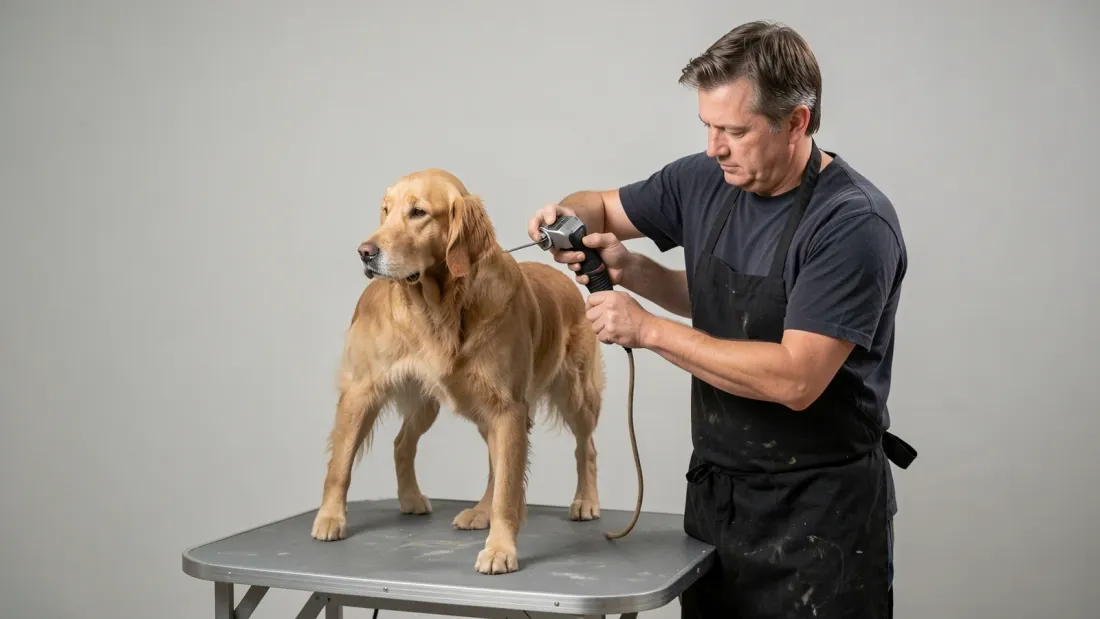
Dog Grooming Clippers: What to Look For Before You Buy
Start with the coat, not the kit
A lot of first clipper sets in this house have had a short career. Someone buys a loud, heavy machine because it looks “professional,” the dog decides the bathroom is now a trap, and the box goes back in the closet. The useful question is narrower than “which are the good dog grooming clippers?” It is whether clippers are the right tool for this dog, this coat, and this household.
Clippers are for shortening a coat in a fairly even way, usually over the body. They are not the same thing as a dog grooming hair trimmer, which is a smaller tool for faces, paws, and tidy edges. If what you actually need is a neater face or less fur between the pads, a full-size clipper is the wrong first purchase. If the coat is badly matted, clippers are also the wrong first move. Mats can sit tight to the skin. Working through them at home, especially with scissors, is how people nick a dog they were trying to help. In those cases, a professional groomer is the safer option.
The American Society for the Prevention of Cruelty to Animals is clear on a related point that many summer ads ignore: it is one thing to tidy long hair, and another to shave a pet down to the skin. The ASPCA advises against shaving, and recommends leaving actual haircutting to a professional when you want a shorter “summer cut.” Their guidance on summer shaving and their broader dog grooming tips are worth reading before you order a kit. This article is about choosing a tool, not about diagnosing skin or coat disease. If the skin looks sore, the coat is coming out in unusual patches, or your veterinarian has already flagged a skin condition, ask that veterinarian before you clip.
What “professional” actually changes
Listings love the phrase professional dog grooming clippers. In a salon, that usually means a machine that can run through several dogs, take interchangeable blades, stay relatively cool, and be serviced when a blade or a drive part wears out. At home, you probably need a quieter, lighter machine that will do one familiar dog without overheating, plus blades or combs you can actually buy again next year.
A cordless body clipper is convenient if your dog will not stand near an outlet, or if you groom in a yard. The tradeoff is charge time and the fact that power can sag at the end of a battery cycle, which is exactly when you may be working around elbows and armpits. A corded clipper can be steadier for a long session, but only if the cord will not snag a skittish dog. Neither format is “better” in the abstract. Match it to the room and the dog.
Blade systems matter more than color or included accessories. Look for a system with clearly marked lengths, a way to oil and clean the blade, and spare blades or snap-on combs that fit the same body. A kit stuffed with combs you will never use is not a feature. A single spare blade and a small bottle of clipper oil often are.
A buying table for home clippers
Use this as a filter, not as a lab test. We are not publishing timed trials or invented decibel scores. You can check most of these points on the box, in the manual, or by handling the tool in a shop.
| What to check | Why it matters at home | A reasonable sign | A warning sign |
|---|---|---|---|
| Job the tool is built for | Body clipping is a different job from trimming a muzzle or a paw | The maker describes it as a dog body clipper, with body-length combs or blades | It is a human hair trimmer, or a tiny detail tool sold as if it will do a whole coat |
| Blade or comb lengths | You want to leave a protective length, not shave to the skin | Numbered combs or blades that leave a clearly longer coat | Only a bare blade, with no guidance on remaining length |
| Noise and vibration | A frightened dog will not stand still, and a wriggling dog is how nicks happen | A demo in a shop, or a return policy if your dog cannot tolerate the sound | “Silent” claims with no way to return the tool if the dog panics |
| Heat at the blade | A hot blade can scald thin skin, especially in armpits, groin, and folds | A design you can pause, a second blade you can swap, and oil in the kit | No mention of oiling, and no way to change a blade mid-session |
| Weight and grip | You will hold it over a moving dog, often in one hand | You can hold it steadily at arm height for a minute without your wrist folding | A heavy body with a skinny, slippery handle |
| Power supply | The session should not die halfway through the ribcage | A cord long enough to stay out of the way, or a battery that completes one full groom with margin | A short charge and no way to use the tool while it sits on a stand |
| Cleaning and parts | Hair packed in the blade makes it pull and heat up | A brush, oil, and a published source of replacement blades | A sealed blade with no spare parts and no cleaning advice |
| Your dog’s coat and skin | Thick double coats, tight curls, and already-matted fur do not behave the same | You know the coat type and have already brushed it out | You plan to “just shave the mats off” as a first home project |
If two models look similar, pick the one with replaceable blades and a return window. Features you cannot service will not stay “professional” for long.
A calmer first session
Brush first. Clippers do poorly in a dirty, tangled coat, and they do worse in a wet one unless the tool is specifically made for that use. The ASPCA’s basic grooming advice starts with brushing to remove dead hair and mats before a bath; the same logic applies before you clip. Work on a non-slip surface, in good light, when you are not in a hurry. Have a towel, blade oil, a brush, and treats ready before the clipper is turned on.
Let the dog hear the clipper in another part of the room, then feel the still, switched-off body against the shoulder, then a short pass in a low-stress area such as the back. Do not begin under the ear or in the armpit. Keep the skin smooth with your free hand so the blade does not dig into a fold. If the blade feels warm on the back of your hand, stop and swap or cool it. If the dog tries to leave, stop. A half-finished, trustworthy session is better than a complete groom the dog will not let you repeat.
Leave more coat than you think you want, especially on the first try. You can always go shorter later. You cannot put hair back, and you cannot undo a razor-close pass on a pale undercoat that then sunburns. Around the face, ears, and genitals, slow down or switch to a smaller trimmer if you have one. If you meet a mat that will not lift with a brush and patience, leave it for a groomer.
Afterward, brush again, check the skin, and clean the blade. Hair, oil, and a dull edge are the usual reasons a “good” clipper starts to chew instead of cut. Store the kit where a curious dog cannot chew the cord.
A short checklist before you click buy
- I need a body clipper, not a face-and-paw trimmer
- The coat is brushed, and any serious matting will go to a professional
- The kit can leave a longer length, not only a close shave
- I can oil, clean, and replace the blade
- I have a plan for noise, heat, and a non-slip place to work
- I will ask the veterinarian first if the skin is already irritated
- There is a way to return the tool if this particular dog cannot tolerate it
A few honest questions
Are expensive salon clippers always the right home choice?
Not always. Salon machines are built for volume and for people who change blades all day. At home, a lighter, quieter tool with parts you can buy locally will often get more use. Pay for serviceability and a length you can live with, not for a logo.
Can clippers replace brushing and bathing?
No. Clippers shorten hair. They do not remove the need to brush, and they do not replace a bath when the coat is dirty. A clean, brushed coat is easier and safer to clip. The ASPCA’s grooming pages are a better starting point for that routine than any product listing.
What if my dog has a double coat?
A double coat is not a reason to rush into a close clip. The outer hair and the softer undercoat do different jobs, including weather protection. If you are clipping at all, leave length, brush thoroughly, and get advice from a groomer who knows the breed. Do not treat clippers as a shortcut through seasonal shedding.
Should I clip a matted dog at home to save a salon visit?
If the dog is tightly matted, especially close to the skin, this is the moment to call a professional, not to press harder with a blade or a pair of scissors. Home clippers are for a coat you can already get a brush through.