Dog Grooming Tools: Buyer's Checklist
The kit is smaller than the aisle wants you to believe
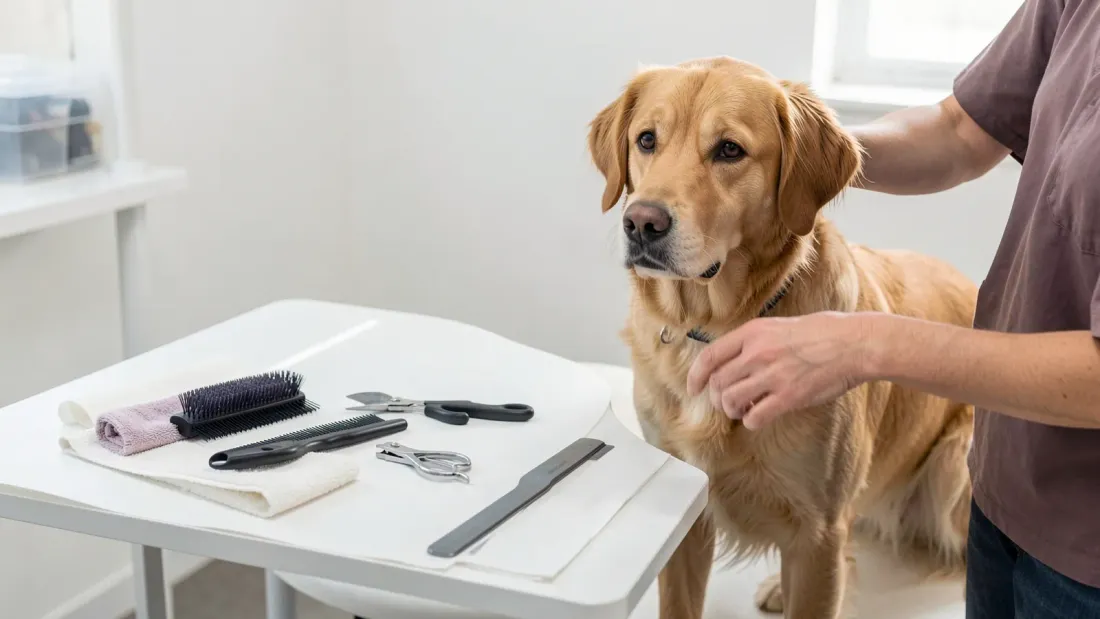
The first time we stood in front of a wall of dog grooming tools, we almost bought a suitcase. Brushes in three shapes, clippers that promised a salon, a trimmer, a mat splitter, nail equipment, and a bottle of something that smelled like a candle. What we actually used, week after week, was smaller: a brush that matched the coat, a comb for the places the brush missed, clippers only when the coat and the dog allowed it, and a trimmer for faces and paws. The rest became drawer clutter.
This is a buyer’s checklist for that smaller kit. It is not a grooming lesson, not a medical guide, and not a test of brands. For coat care in general, the ASPCA’s dog grooming tips are a better official starting point than a store display. If a dog’s skin, ears, or nails already look wrong, stop shopping and speak to a veterinarian. Tools do not replace that visit.
Start with the coat you have, then fill gaps. A short, simple coat needs a different brush than a long or curly one. A doodle mix and a smooth beagle will not share a kit happily. If you live with a Cocker, the coat and ears ask for a more patient routine than a “universal” gift set; we wrote about that separately in Cocker Spaniel dog grooming.
Start with the coat, then add only the tools that have a job
The tool we use most is the brush, because it is the one that comes out on an ordinary evening. Slicker, pin, bristle, or rubber: the shape should match the coat, not the packaging. A slicker that is too harsh on a thin coat is as useless as a soft bristle brush on a dense undercoat. We go through that choice in detail in our guide to a dog grooming brush, including how a session should feel. If you buy only one thing this month, buy the brush you will actually run over the dog.
Clippers are a different job. They remove coat in bulk, they get hot, and they ask for a calm dog and a dry, detangled coat. They are not a faster brush. If you are choosing a set, our dog grooming clippers checklist covers motor type, blades, noise, and what “professional” usually changes in a home kit. A trimmer is smaller still: faces, paws, sanitary areas, and tidy edges, not a full body clip. We treat that as its own tool in dog grooming hair trimmer, because a “clipper and trimmer set” on a website is sometimes just one awkward machine with two labels.
Combs, rakes, and mat tools can earn a hook on the wall if the coat mats, but they are easy to over-buy. A metal comb is useful to check what the brush missed. A mat splitter in untrained hands can cut skin. If a coat is already tightly matted, the kinder path is a professional groomer or a veterinarian, not a new blade and a YouTube dare.
Nail equipment, ear wipes, and toothpaste sit in the same aisle and are not automatically part of a first grooming kit. If you add them, get a demonstration from a groomer or vet clinic first, and never invent a technique from a still photo. This article will not walk through cutting nails or cleaning ears.
A table of tools by job, not by gift set
| Job you actually have | Tool that usually earns its keep | What to look for before you buy | What to leave on the shelf |
|---|---|---|---|
| Everyday loose hair and early tangles | A brush matched to the coat, plus a comb to check your work | A shape that reaches the coat you have, a handle you can hold, a feel the dog will tolerate | A five-brush gift box “for all coats,” when you have one dog |
| A body clip at home | Clippers with a blade and a power supply that can finish the job without cooking the coat | Noise the dog can live with, blades you can clean, a way to keep the coat detangled and dry first | The loudest “professional” kit, bought the night before a new haircut |
| Faces, paws, tidy edges | A small trimmer, used as a detail tool | A head that fits the tight spots, a comfortable hold, easy cleaning | A full-size clipper forced under an eye, or a human trimmer from the bathroom drawer |
| Checking for hidden snarls | A wide-toothed metal comb | Smooth teeth, no sharp burrs, a length that fits the coat | A cheap comb that scratches your own hand when you test it |
| A coat that is already tightly matted | A professional appointment, not a new gadget | Honesty about what you can safely do at home | Scissors or a mat tool used as a shortcut through tight fur against the skin |
If two rows apply, buy for the row you will do this week. A clipper will not brush the sofa. A beautiful slicker will not clip a retriever.
How a first home session actually goes
On our first try we laid every new tool on the kitchen table, like a surgery. The dog left. The better version, later, was shorter: brush first, in a room with a non-slip floor, with breaks, and with only one new sound at a time if clippers were coming out. The ASPCA’s grooming tips emphasize regular brushing to prevent mats, and they are blunt about not taking scissors to mats yourself. That matched what we learned the hard way: a tangled coat is a brushing problem or a professional problem, not a “just cut it out” problem.
We also learned to stop before the dog was done with us. A short session that ends calmly is a tool you can use again. A perfect haircut that frightens the dog is a kit that will live in a cupboard. If the dog says no, the tool is not “failing.” The plan is.
Keep a towel, a charger or spare batteries, and a brush within reach before you start. Hunting for a blade on the floor mid-clip is how we once turned a quiet evening into a chase. Store blades dry, and do not share clipper oil with the salad drawer. Ordinary housekeeping is part of the kit.
A short buying checklist
- Name the coat and the job (daily brushing, occasional tidy, or a full clip) before you look at sets.
- Choose the brush first, and test the feel on your own hand, then on a short, calm session.
- Add clippers only if you will clip, and a trimmer only if you have a detail job the clippers will not do well.
- Read official grooming guidance, starting with the ASPCA page linked above, rather than a product video alone.
- Skip scissors-against-the-skin shortcuts, and do not buy a mat tool as a substitute for a professional when the coat is already tight to the skin.
- Leave medical questions, sore skin, and ear or nail problems to a veterinarian.
- Buy the smallest kit you will use twice, not the largest kit you will photograph once.
If the checklist makes the suitcase-sized set look silly, that is the checklist doing its job.
Questions people ask while staring at a wall of tools
What dog grooming tools do I actually need to start?
A coat-matched brush and a comb will cover more weeks than any other pair. Add clippers or a trimmer only when you have a clear job for them and a dog that will tolerate the sound and handling. A first kit does not have to look like a salon.
Are “professional” tools always better at home?
Not always. In a home kit, “professional” should mean a machine you can finish a job with, clean, and live with for noise and weight, not a word printed in gold. Our clippers guide is the longer version of that answer.
Can I use human clippers or a human hairbrush?
We would not. Dog coats, blades, and the way a dog moves are not the same problem as a human haircut. Buy tools meant for dogs, then match them to the coat. If you are unsure, ask a groomer to name the tool they would use on this dog, and ignore the gift aisle.
How often should I use each tool?
Often enough to prevent mats and to keep the dog comfortable, which varies with coat type and season. The ASPCA discusses regular brushing and other home-care basics on its grooming-tips page; use that official guidance, and your groomer or veterinarian, rather than a calendar we invented. If brushing becomes painful for the dog, stop and get hands-on advice.